
Please note, these facilities DO NOT provide tours. They are available to that university's forensic students, researchers, FBI, and law enforcement agencies.
A body farm is an outdoor research facility that allows forensic anthropologists to study the decomposition of human remains in a natural environment under natural circumstances.
 |
| Remains are Protected |
By learning the stages of decomposition, researchers can better determine the time and causes of death, which is especially helpful in solving cold cases – deaths and murders that have not been solved.
Researchers also learn the speed at which a body decomposes based on the body’s age, body size, clothing worn, cause of death, location, and environment. This information is used by medical examiners, law enforcement, and crime scene investigators to solve murders, suspicious deaths, and other criminal cases.
What Happens to a Body on the Farm?
When the body arrives, it will receive a number to protect privacy and assist in record keeping. Hair and other samples are taken before the body is moved to the outdoor research lab and allowed to decompose. Some bodies are placed in wire cages, others are allowed to experience the full effects of nature. Bodies may also be placed in vehicles, campers, or submerged to aid in research for homicide investigations.
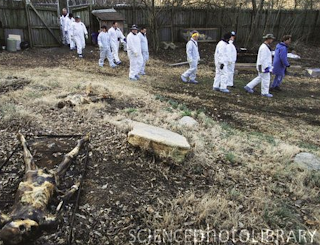 |
| Students Learn in the Field |
During this time, students monitor and take notes on the effects of weather, environment, insects, and scavengers on the body. It usually takes about six months for a body to become skeletal. But again, this depends on the circumstances, location, and effect of weather and environment on the corpse.
Skeletal remains will be taken, cleaned, and inventoried into a permanent collection used for research and education. Many facilities allow families to visit their loved one's skeletal remains.
Where Do the Bodies Come From?
Body farms receive human remains from three sources:
1. Medical examiners turn over bodies that have not been claimed.
2. Family members may donate a loved one’s body.
3. People complete a pre-donor consent form to donate their bodies after death.
The First Body Farm
Forensic Anthropology Center – Knoxville, Tennessee

The first body farm was started at the University of Tennessee in Knoxville by Dr. William Bass. Bass, a forensic anthropologist, joined the Tennessee Medical Examiner’s office but realized he didn’t understand how physical remains decayed. He started the first “body farm” outside of Knoxville in 1972 with one body on a 2.5-acre wooded lot where he intended to study human decomposition in a variety of settings.

William Bass
By 1987, Bass had founded the Forensic Anthropology Center (ARF) where students could learn more about forensic anthropology. Today, around 50 bodies are always out in the elements. Some are clothed, some naked, some are placed in potential crime scene locations, like cars, woods, and underwater.
Forensic students at U of T learn that numerous factors can affect the deterioration of a body including moisture, temperature, sun, shade, soil chemistry, and insect activity. They keep records and observe the body’s decomposition process over the four stages: fresh, bloat, decay, and dry.
Besides educating students, AFR trains members of NCIS and the FBI’s Evidence Recovery Team in scene-of-the-crime skills and other techniques. The facility is now researching the effects of bodies found in mass graves.
ARF has studied more than 1,800 bodies. The Tennessee facility is also home to 1,700 modern skeletal remains, the largest collection in the world.
U of T receives more than 100 donated bodies each year.
If you are interested in learning how to donate your body here, contact donateinfo@utk.edu
Body Farm Number Two
Western Carolina University – Cullowhee, North Carolina
 |
| Lab at FOREST |
The Forensic Osteology Research Station (FOREST) was established in 2007, making it the second body farm in the U.S. The grounds are at Cullowhee, North Carolina, near the Great Smoky Mountains, located at an altitude of 2,271 feet above sea level. This altitude offers different effects on the decomposition of bodies like temperatures, humidity, and animal scavengers.
FOREST has three educational goals:
1. The study of decomposition and taphonomy, the study of fossilization.
2. Systematic location and recovery of human remains
3. Human skeletal biology
 |
| Cadaver Dog |
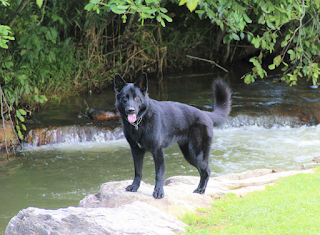
FOREST has a twice-yearly cadaver dog training program. Cadaver dogs learn how to locate bodies that have been underwater and in shallow graves along with bodies hidden in mountainous terrain, and bodies disposed of in buildings and vehicles. Cadaver dogs are used to assist law enforcement in locating and recovering a body more quickly.
This facility is also studying the degradation rates of nuclear DNA in soft tissues and bone. To donate, contact wcubodydonation@wcu.edu
Largest Body Farm in the U.S.
Forensic Anthropology Research Facility - Texas State University, San Marcos, TX

Texas State University is the home of Texas State Forensic Anthropology Research Facility (FARF), which began in 2008. It is the largest body farm in the country, composed of 26-acres for research purposes. Fifty bodies are left out in the elements at any one time for study.
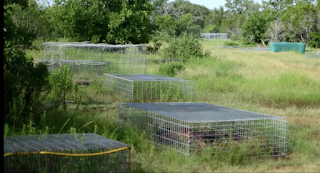
FARF allows students to study the decomposition of human remains, many placed in 2-foot cages where only insects, weather, and bacteria will affect them. Remains are also left without protection so researchers can study the effects scavengers have on the body. Students then learn how the bodies interact with their total environment. These findings can assist in solving cold cases.
Remains may also be used in several workshops including Identifying Human Bones, K9 Human Remains Detection, Human Remains Recovery Course, and Skeletal Death Investigation.
 |
| Body in Cage to Protect It |
The TSU skeletal collection allows students to study the effects of different causes of death and how it affects the body’s skeleton.
Courses are also offered throughout the year for numerous agencies including the Tennessee Bureau of Investigation, Kentucky Criminalistic Academy, and the Federal Bureau of Investigation.
The Forensic Anthropology Center accepts the donation of bodies for scientific purposes. Those bodies will stay at the ranch facility. However, families are allowed to visit the remains. Currently, there are more than 4,000 registered pre-donors. For information on donating your remains, contact FACTS@txstate.edu
Complex for Forensic Anthropology Research Southern Illinois University
– Carbondale, Illinois

The Complex for Forensic Anthropology Research (CFAR) at Southern Illinois University in Carbondale, Illinois is an outdoor research laboratory that focuses on research, training, and the study of forensic anthropology.
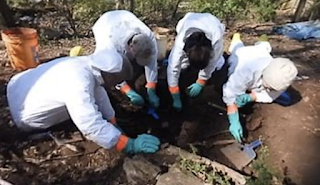 |
| Students Keep Track of Decay Rate |
Students study the rate and pattern of decaying bodies from the local climate and insect activity. CFAR students also study body disposal and how it affects the remains and decomposition for forensic purposes.
The facility works with medio-legal agencies in body recovery, trauma analysis, skeletal research, and court testimony. SIU offers non-credit short courses, one-day training sessions for law enforcement and professional organizations, and traditional semester forensic anthropology and taphonomy classes.
For donation information, contact gdabbs@siu.edu
Why Donate?
Donating your body to aid in the study of forensic research investigations and cold cases is a noble option. This is also seen as a “green alternative” to embalming and traditional burial. And these facilities offer an alternative for those who cannot afford burial or cremation.
 |
| Taking Notes of Body Locations |
can be studied and stored. These facilities operate in the same manner of any other scientific tissue donation system. There is paperwork to identify the remains, and the transfer from a relative to the facility, which allows it to take possession of the body.
~ Joy


